Adjustable closet rods: when telescoping is fine, and when it isn't
An adjustable closet rod is two tubes that slide together to fit your opening. No cutting, no exact measuring, and you can reuse it in a different closet later. The tradeoff is strength: the joint between the tubes is the weak point.
4-minute read · Part of the full closet rod bracket buying guide
🔧 The short version
- 01Buy a rod whose adjustable range puts your opening in the middle, not at the maximum. More overlap between the tubes means a stiffer rod.
- 02Adjustable rods are weaker than a solid rod of the same size. Use them for normal clothing loads and add a center support on longer spans.
- 03Check the end diameter. Many adjustable rods don't match the 1-5/16" standard, so your brackets have to match the rod.
How adjustable rods work
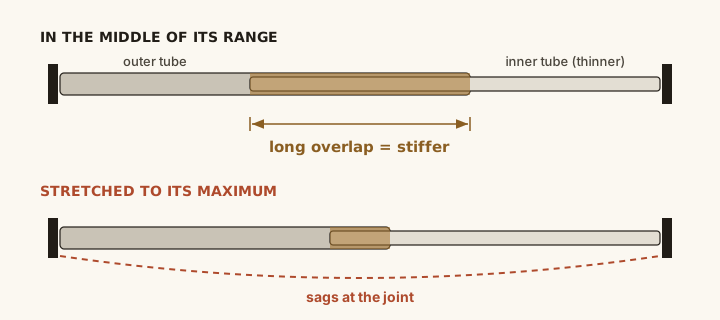
A slightly smaller inner tube slides inside an outer tube. Once the rod spans your opening, the ends sit in brackets and the overlap holds it together. Some models lock with a screw; most simply rely on the brackets to hold the length.
The weak point is where the tubes overlap, and the inner tube is thinner than a solid rod would be. That is why adjustable rods sag sooner than fixed rods, especially when stretched near their maximum length.
Choosing the right range
| Your opening | What to buy |
|---|---|
| Short reach-in (about 2–3 ft) | A short-range rod; extend it only partway |
| Standard reach-in (about 3–4 ft) | A mid-range rod with your width near the middle of its range |
| Wide reach-in (about 4–6 ft) | A long-range rod plus a center support near the joint |
| Walk-in runs over 6 ft | A fixed, cut-to-length steel rod with center supports |
Adjustable rod vs tension rod
Sits in brackets
The ends rest in wall-mounted brackets that carry the load into the wall. Suitable for everyday closet use when installed properly.
Held by spring pressure alone
Pushes against both walls with an internal spring, with no screws. Fine for a few light items, a curtain, or a temporary fix in a rental, but it can slip under a full load of clothes. Don't rely on one as a main closet rod.
When to add a center support
Use the same span limits as fixed rods, but stay toward the lower end. The joint makes an adjustable rod more flexible. When you add a center support, place it near the overlap if you can, since that is where the rod bends first. The support must match the diameter of the tube it grips.
| Rod type | Max unsupported span |
|---|---|
| Oval rods (steel or aluminum) | ~4 ft |
| Round, 1-1/16" diameter | ~5 ft |
| Round, 1-5/16" diameter | ~6 ft |
What to buy
We haven't yet found an adjustable rod with enough review and spec data to recommend confidently. When you compare listings, check:
- The length range, with your opening near the middle.
- The end diameter, and whether the rod includes matching brackets.
- The material: steel over aluminum or plastic-coated tubing.
- A stated load rating at a given length.
If you're buying brackets separately, see the closet rod holder guide for how to match holders to your rod.
Frequently asked questions
Are adjustable closet rods strong?
Strong enough for typical clothing in reach-in closets. They are weaker than solid rods because of the overlap joint and thinner inner tube, so use a solid steel rod for heavy loads or long spans.
How do I pick the right size adjustable closet rod?
Measure your opening wall to wall and choose a rod whose range puts that measurement near the middle. More overlap between the tubes makes a stiffer rod.
Do adjustable closet rods need brackets?
Yes. Unlike tension rods, adjustable closet rods rest in end brackets screwed to the wall. Many are sold with matching brackets. If not, match the brackets to the rod's end diameter.
Can I use a tension rod in a closet?
For light items and short spans, yes. A tension rod relies only on spring pressure, so it can slip under a full load. Use a bracketed rod for your main hanging space.
Affiliate disclosure
Closet Rod Bracket is reader-supported. When you buy through links on this site, we may earn an affiliate commission through the Amazon Associates program, at no additional cost to you.