Closet rods: sizes, materials, and how to pick the right one
A closet rod looks like the simplest part in a closet, but its diameter decides which brackets fit, its material decides how much it holds, and its length decides whether it sags. Here is how to get all three right.
5-minute read · Part of the full closet rod bracket buying guide
🔧 The short version
- 011-5/16" is the standard diameter today. 1-1/16" and 1-1/4" are common too, and brackets must match the rod exactly.
- 02Steel is the strongest common material and wood is the classic look. Oval and aluminum rods are lighter-duty and need supports sooner.
- 03Cut the rod to fit between its brackets, and add a center support past roughly 4–6 ft depending on the rod.
Closet rod diameters
Diameter is the first thing to settle, because it decides which holders, center supports, and combo brackets will fit.
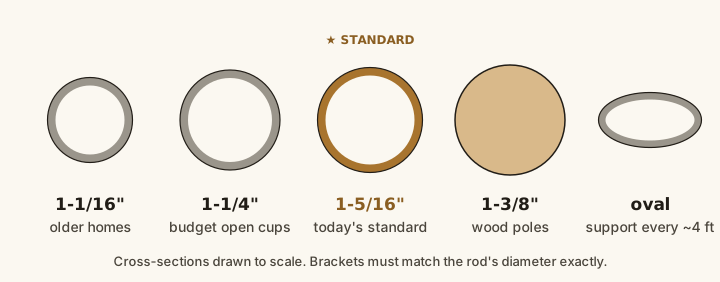
| Diameter | Where you'll find it | Notes |
|---|---|---|
| 1-1/16" | Older homes, basic builder-grade closets | Lower load capacity; thinner wall in metal versions |
| 1-1/4" | Budget and open-cup (U-shaped) hardware | Very common in Amazon best sellers |
| 1-5/16" | Current industry standard, most new construction | Standard for heavy-duty hardware |
| 1-3/8" | Wood closet poles | Check that your brackets list this size |
Materials and shapes
Strongest for the money
A round 1-5/16" steel rod carries roughly 170 lb over a 6-ft span when stud-mounted. Finish is cosmetic. It is the default choice for walk-ins and heavy loads. See heavy duty closet rods.
Classic look, moderate strength
Wood poles (often pine or oak) look warm and are easy to cut and paint. They carry less, roughly 30–50 lb over 6 ft, and can take on a permanent sag if overloaded.
Light and rust-proof
Easy to cut and handle, but noticeably weaker than steel at the same diameter. Fine for short spans and light clothing.
Sleek, modern, shorter spans
Oval rods are common in modern closet systems and hold hangers from sliding around. They need support sooner: about every 4 ft.
Looks first
Usually brass-plated steel. Check the underlying material and diameter to judge strength, and match the finish to your brackets.
No cutting required
Two tubes slide together to fit a range of widths. Convenient, but the overlap joint is the weak point. See adjustable closet rods.
Measuring and cutting to length
- Measure wall to wall at rod height, in two or three places. Closets are rarely square, so use the shortest measurement.
- Subtract for the brackets. Closed sockets usually need the rod slightly shorter than the wall-to-wall distance so it can drop in. Follow the bracket's instructions; ¼" is a common allowance.
- Cut metal rods with a pipe cutter or a fine-tooth hacksaw, then file the burr off the cut end. Cut wood poles with any fine saw.
- Check the span. If it passes the limits below, plan a center support before the rod goes up.
| Rod type | Max unsupported span |
|---|---|
| Oval rods (steel or aluminum) | ~4 ft |
| Round, 1-1/16" diameter | ~5 ft |
| Round, 1-5/16" diameter | ~6 ft |
Which closet rod should you buy?
| If you're... | Choose |
|---|---|
| Building a walk-in or hanging heavy coats | Steel, 1-5/16" round, with a center support |
| Replacing a rod in an older home | Match the existing bracket diameter, or replace brackets too |
| Going for a furniture-style look | Wood pole or brass finish, shorter spans |
| Renting or avoiding cutting | Adjustable telescoping rod, light loads only |
| Using the corner of an L-shaped closet | See corner closet rods |
| Adding a rod above your reach | See pull-down closet rods |
Brackets to pair with your rod
Once you know your rod diameter, these are the end brackets we recommend.
Stud-mounted rod & shelf bracket
Heavy Duty Closet Rod & Shelf Bracket, black, 3-pack
Check current price → ASIN B08P6J649QOpen-cup end holders for lighter loads
Stainless steel U-shaped open-cup holder, 1-1/4" diameter, screws & anchors included
Check current price → ASIN B0B4WKBZ69Match these to your rod diameter: the first fits 1-5/16" rods, the second 1-1/4". For all bracket types, see the main buying guide and the closet rod holder guide.
Frequently asked questions
What size is a standard closet rod?
1-5/16" in diameter is the current standard in most new construction. Older homes often have 1-1/16" rods, and many budget holders are sized for 1-1/4".
Is a wood or metal closet rod better?
Metal, specifically steel, is stronger and resists sagging. Wood looks warmer and is easy to cut and paint, and works well on shorter spans with normal clothing loads.
How long can a closet rod be without support?
About 4 ft for oval rods, 5 ft for 1-1/16" round rods, and 6 ft for 1-5/16" round rods. Beyond that, add a center support.
How high should a closet rod be?
Standard is 66" from the floor for a single rod. See the closet rod height guide for double-hang and long-hang heights.
Can I cut a metal closet rod?
Yes. A pipe cutter gives the cleanest cut and a fine-tooth hacksaw works too. File or sand the cut edge smooth so it doesn't snag clothes or scratch the bracket.
Affiliate disclosure
Closet Rod Bracket is reader-supported. When you buy through links on this site, we may earn an affiliate commission through the Amazon Associates program, at no additional cost to you.