Corner closet rods: how to hang clothes around an L-shaped corner
Corners are where closet layouts waste the most space and cause the most frustration. Rods that meet in a corner either leave a dead zone or make hangers collide. Here are the three ways to handle it and what each needs.
4-minute read · Part of the full closet rod bracket buying guide
🔧 The short version
- 01If two rods meet at the same height, the hangers near the corner collide. Plan for it: either leave a gap or change heights.
- 02Your options: stop one rod short, use a corner connector to join two rods at 90°, or use a curved corner rod.
- 03Wherever rods meet in a corner, support the joint from a shelf above or a corner post. The joint carries load from both runs.
Why corners are tricky
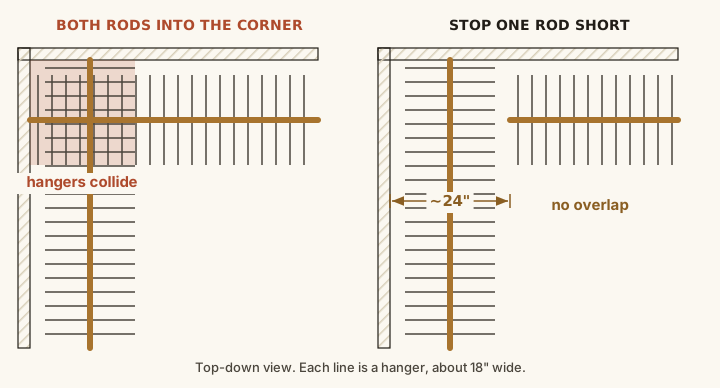
Clothes on a hanger take up about 20–24" of depth, which is why rods sit about 12" out from the back wall. When two walls of rods meet in a corner, the clothes on each rod stick out into the space the other rod's clothes need. The last several hangers on each run end up crushed into each other.
The result: a corner that looks usable on paper but only holds a few garments in practice. The fix is to design the corner on purpose instead of running both rods into it.
Three ways to handle the corner
Stop one rod short
Run one rod all the way into the corner and stop the other about one hanger-width short of it, roughly 12–24" depending on your closet. It is the simplest, cheapest option, and the rods stay fully independent.
Offset the heights
Run one wall as double-hang (rods at about 81" and 41") and the other as single-hang (about 66"). The clothes sit at different levels and clash much less. See closet rod heights.
Corner connector
An L-shaped fitting joins two straight rods at 90° so hangers can slide around the corner. It needs rods of the same diameter and a support at the joint, and the corner itself is still tight for hangers.
Curved corner rod
A pre-bent rod sweeps around the corner in a radius, giving hangers a smoother path. It takes more floor space and needs matching end brackets and a support at the curve.
Supporting a corner joint
A corner connector or curved rod carries load from two runs at one point, and that point is usually the farthest from any end bracket. Brace it from a shelf above with a center support bracket, or from a vertical corner post. Then check each straight run against the span limits:
| Rod type | Max unsupported span |
|---|---|
| Oval rods (steel or aluminum) | ~4 ft |
| Round, 1-1/16" diameter | ~5 ft |
| Round, 1-5/16" diameter | ~6 ft |
What to buy
We haven't yet found a corner connector or curved closet rod with enough review data to recommend confidently. For most closets, Option A or B uses standard hardware and avoids the weak joint. If you do buy a connector, check that:
- It lists your exact rod diameter (for example 1-5/16").
- It is metal, not plastic, with screw holes to fix the rods in place.
- You have a plan to support the joint from above.
For closets with a fixed shelf above the rod
Box of 5 — middle mounting bracket for 1-5/16" round closet rods, polished chrome, mounts to the underside of an existing shelf
Check current price → ASIN B01672J7DAFrequently asked questions
How do you hang clothes in a closet corner?
Either stop one rod short of the corner so hangers don't collide, run the two walls at different heights, or join the rods with a corner connector or curved rod and support the joint from above.
How much space do you need in a closet corner?
Hanging clothes need about 20–24" of depth, so the last 12–24" of one run is where hangers from the two walls overlap. Leave that space open, or use it with offset heights or a corner shelf.
Do corner closet rods need a support?
Yes. A corner joint carries weight from two runs and sits far from the end brackets. Brace it from a shelf above or a corner post.
Can I use a corner connector with any closet rod?
Only rods of the diameter the connector is made for. Measure your rods and buy a matching connector, for example 1-5/16" for standard rods.
Affiliate disclosure
Closet Rod Bracket is reader-supported. When you buy through links on this site, we may earn an affiliate commission through the Amazon Associates program, at no additional cost to you.